Learning That History Happens Everywhere... Including at Rice
I often like to think about the history that's right under my nose; the kinds of stories that if someone knew them, they'd be bursting to tell me about. It could be something like a fun bit of trivia about how the street I'm on earned its name or how the actions of someone I never knew about are central to why my life is the way that it is today. Here's one I found out recently: the place I grew up in - Hor al Anz East - was named after a sheikh's horse that died in that area and was buried in a sand dune. Weird, right?
While I was at Rice University, I spent some time in the short-lived Special Projects division of the campus newspaper - The Rice Thresher. Our specialization was doing web-based storytelling of the past and present of Rice. In the course of working there, I got to learn little vignettes about the people who were here before me like the stories of the women who lived through major shifts in access to abortion, the history of gentrification in the surrounding community, and the fact that in 2003 we won the National College Baseball Championship.
It made me internalize the reality that there is a rich history to be understood about Rice, though the four-year nature of undergraduate learning makes institutional memory hard to maintain. I got into the habit then of occasionally wondering how students in the past reacted to major historical events to get a sense of perspective about my place in history. I would often search through an online archive of the Thresher, but I ran into an issue where the OCR model used on the paper was fairly out of date, making it unlikely that many of my searches yielded accurate results. It made that century-long archive of the past feel impenetrable.
Fast forward a few years and suddenly AI models in many domains have gotten really good. A few months ago, I did some digging and found a state-of-the-art OCR model from Nvidia that was perfect for extracting text from newspapers and similar documents. I also found a service that gave access to GPUs in their downtime, so they cost 1/10th the price to rent. In a fit of inspiration, I downloaded the full archive of the Thresher as well as the annual yearbook - the Campanile - and transcribed them with this model for the full ~100 year history spanning 78,645 pages.
Once I had this much more searchable corpus of information, I started digging into it. I was able to ask an agent like Codex or Claude Code to tell me about how students reacted to WWI and it would respond by searching for keywords like "war", "soldier", "army", etc. in issues of the Thresher and Campanile from the 1910s. It would identify the issues that were most relevant, read them to understand the sentiment reflected in them, and then synthesize that information in a way that I could explore further on my own. Here is an example of a question I posed and the final response it synthesized:
Prompt:
Explore the OCR data for the Thresher and Campanile to identify examples of the Rice community reacting to the events of WWI
Final response: (edited to link to the official collection)
Rice students' public reaction was overwhelmingly patriotic, but not uncomplicated: they treated the war as a duty, celebrated service, and felt the disruption deeply.
- Mobilization was welcomed as a campus cause. In September 1917, each mention of military training reportedly drew "wild applause"; the student paper wrote that, because the country was at war, students had "no choice but to work." Thresher, Sept. 29, 1917 p. 1 and p. 2
- Students accepted a heavily militarized daily life: ROTC/SATC drill, guard duty, and academic work. Women's compulsory military training initially produced some self-conscious laughter, but the paper urged them to treat it seriously; the yearbook later said military drill replaced women's hiking club because there was no time left to hike. Thresher, Sept. 29, 1917 p. 2 and Campanile 1919 p. 165
- Service and sacrifice became a point of collective pride. The 1919 Campanile counted 400 stars on Rice's student service flag, excluding the several hundred SATC members, and described a continuing stream of volunteers. It framed their record as "glorious." Campanile 1919 p. 127
- Those who remained felt conflicted—not relieved. The yearbook says some believed they had been "cheated" of the chance to serve; it insists they were eager to go and envied those who had left. That is likely polished postwar rhetoric, but it is strong evidence of the campus ideal of service. Campanile 1919 p. 133
- The war disrupted ordinary college life. Sports schedules were curtailed, student and faculty departures were conspicuous, and drill competed with classes. Yet the publications often converted disruption into a story of discipline and morale. Thresher, May 4, 1917 p. 1 and Campanile 1919 pp. 131, 145
- After the Armistice, the mood combined relief, pride, and commemoration. Students celebrated returning service members and later memorialized Rice's dead in a reunion toast; the first postwar final ball was described as especially enjoyable. Campanile 1920 pp. 124 and p. 127
One caveat: these are student publications, so they capture the official/public campus voice rather than private dissent. I found little published antiwar sentiment; the earliest Campanile material does preserve a 1916 commencement address calling war a "great wrong," but once the U.S. entered, the student press became emphatically pro-service.
Based on the responses it provided to my various questions, I probed the pages it identified as containing relevant material to get a fuller picture of things and to ensure that an OCR mistake wouldn't translate into a misunderstanding of the original text. I've got instructions for you to be able to explore the archive on your own, but I can give you a sampling below of some of the topics I was curious about and decided to explore.
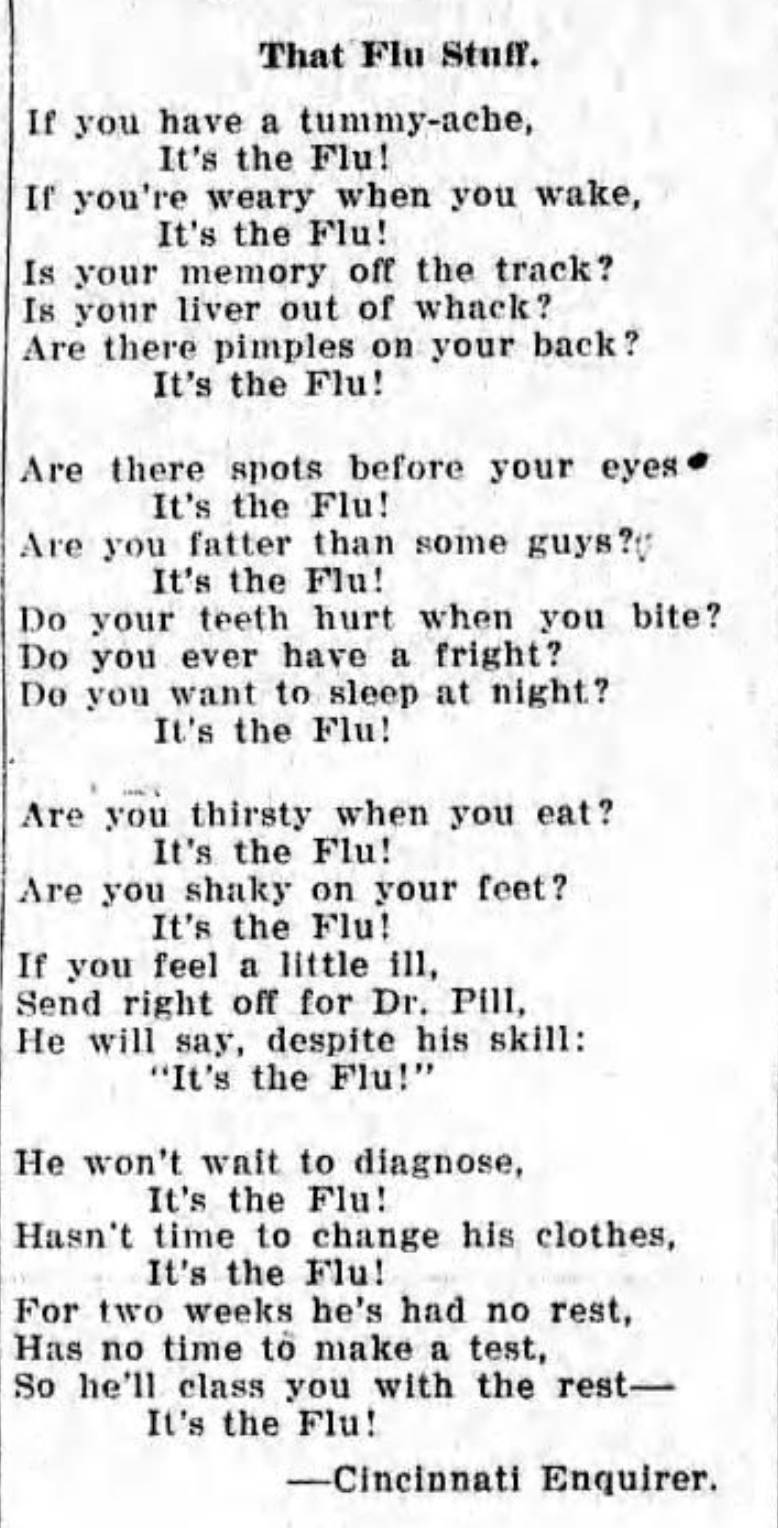
When the COVID pandemic hit, it felt like the sort of thing that you would only have heard about happening in the past. Of course, the Spanish flu had taken place about a century prior, and Rice had been around during that time. Looking at the re-scanned archive, I found an echo of a feeling many had during the more recent pandemic. I remember stifling every minor cough or sneeze for fear of arousing suspicion that I was infected. Some developed hypochondriac tendencies that lasted beyond COVID. I found this gem embedded in a 1919 issue of the Thresher that parodied a similar paranoia from a different era:
In other searches, I learned that the namesake of the Heisman Trophy - John Heisman - was once a coach at Rice. He had just come off a string of successful coaching gigs at other college football programs, and he came to Rice with the intention of invigorating their football program. He wrote several letters to the student body in which he laid out an affirmative vision for the changes he wanted to bring to Rice's athletic program. In one of these letters, he effectively scolds the Rice community for their lack of school spirit around athletics and their under-appreciation of the student athletes. I don't think much has changed since 1924 in that regard.
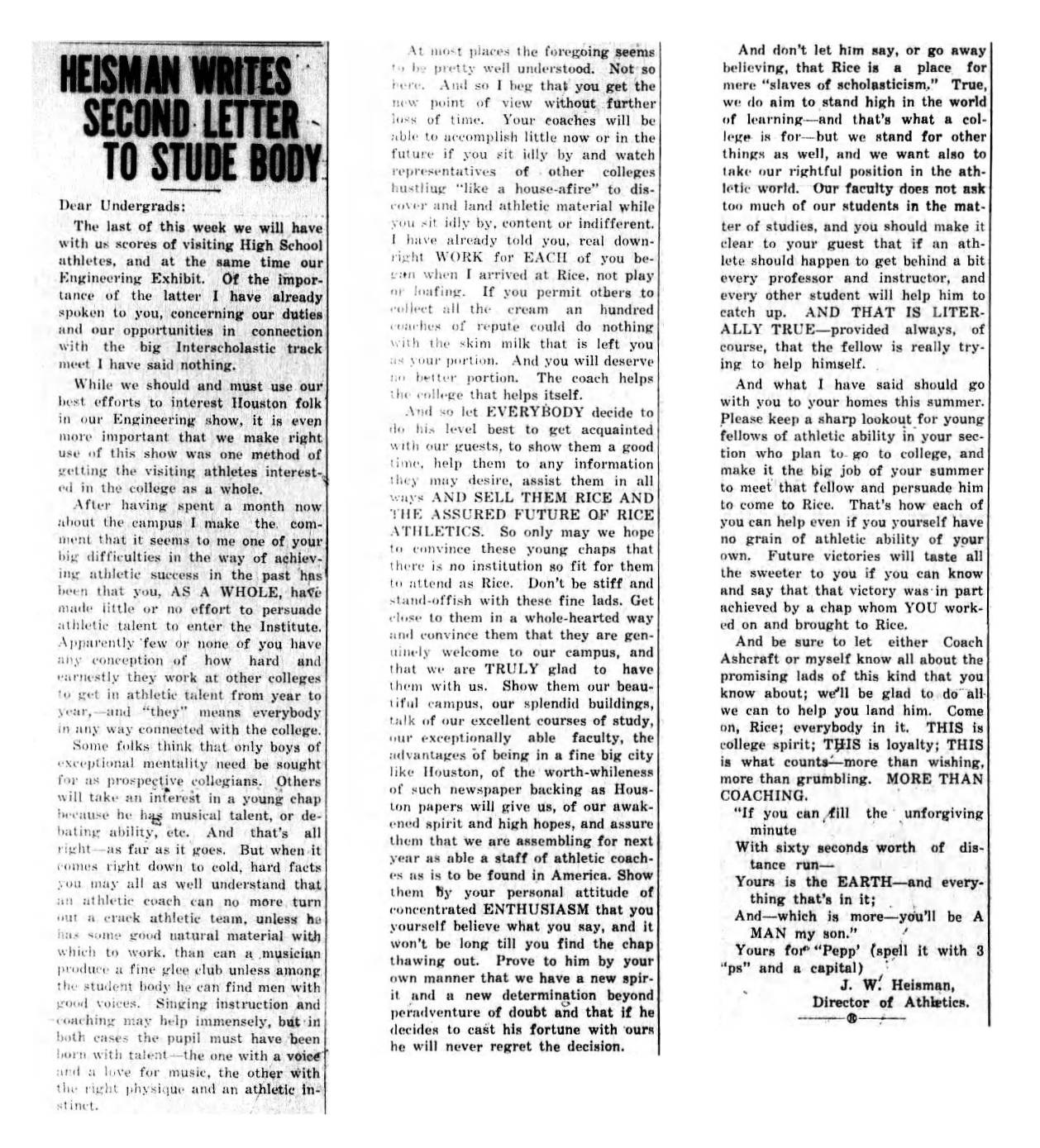
He spent four years at Rice, only to end up with a record that he and others would regard as unsuccessful. Heisman would not go on to coach another college football program.
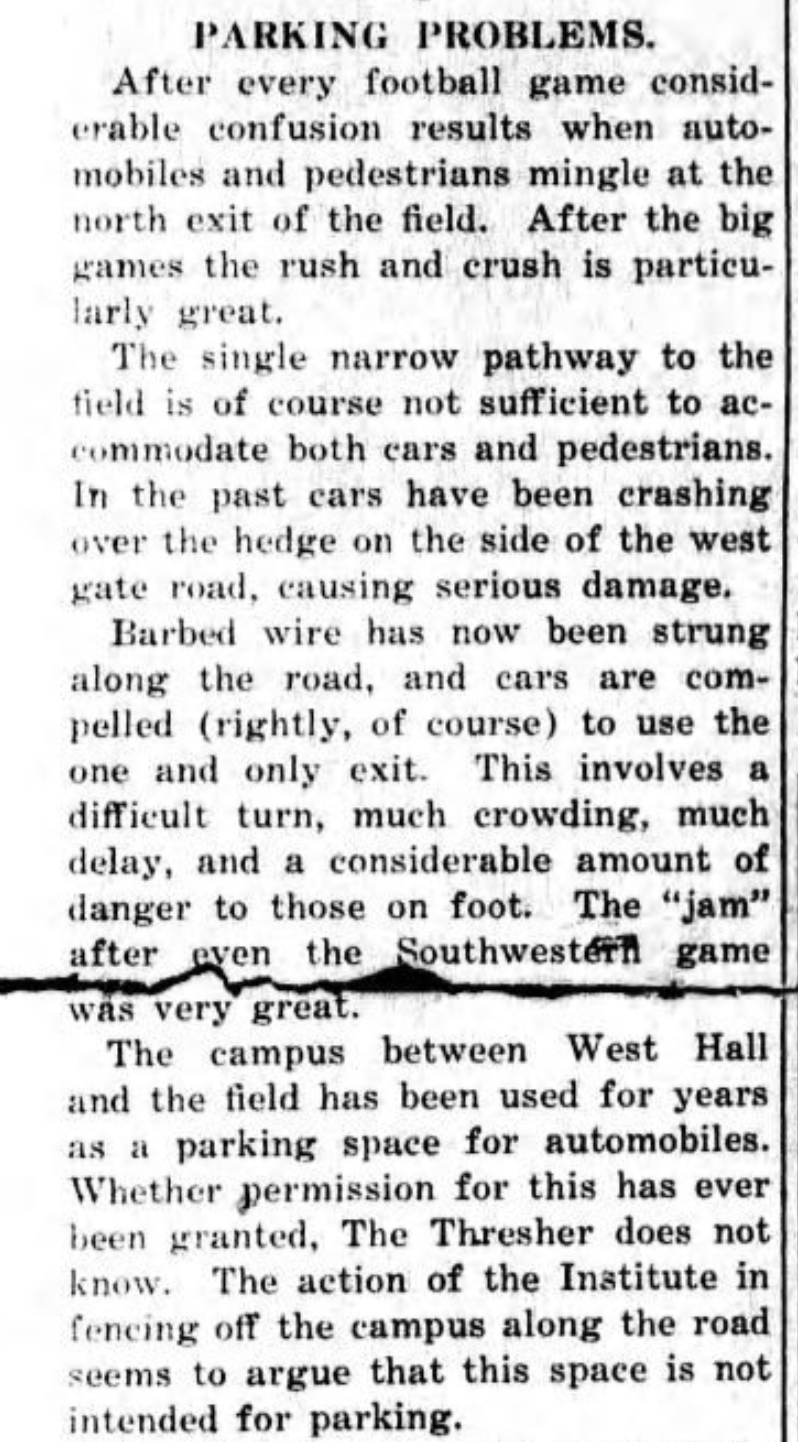
Another thing that hasn't changed? Students complaining about campus food. An opinion piece published in 1918 decried the "evils" present in the food system at Rice, which led to two "food riots." Reading the piece makes it clear that they definitely had it worse back then. A 1922 piece argued for reforms to combat inflexible meal times, and a 1968 piece complained that the food quality had reached "new realms of inedibility." Students also seemingly have a rich tradition of complaining about parking.
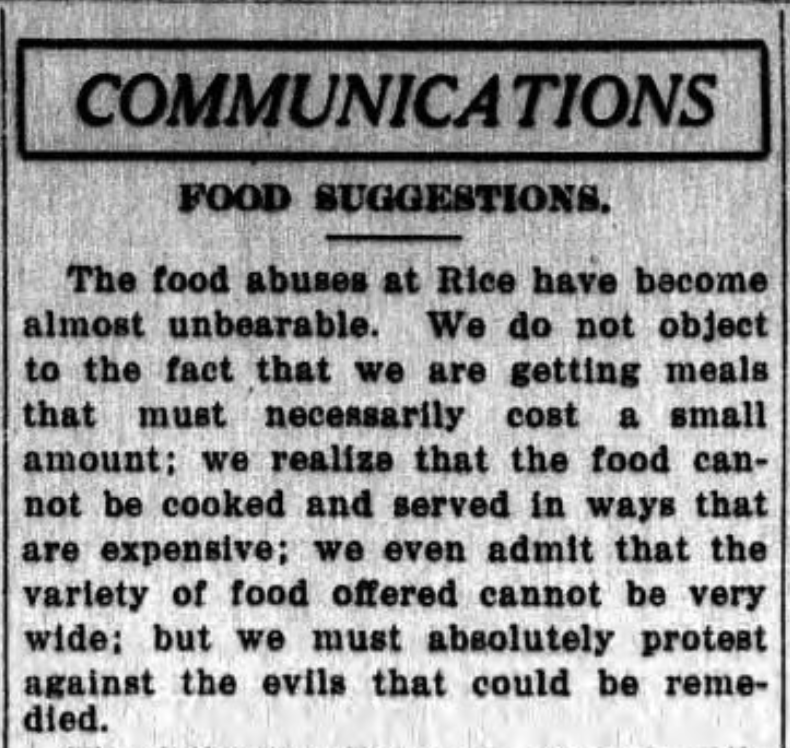
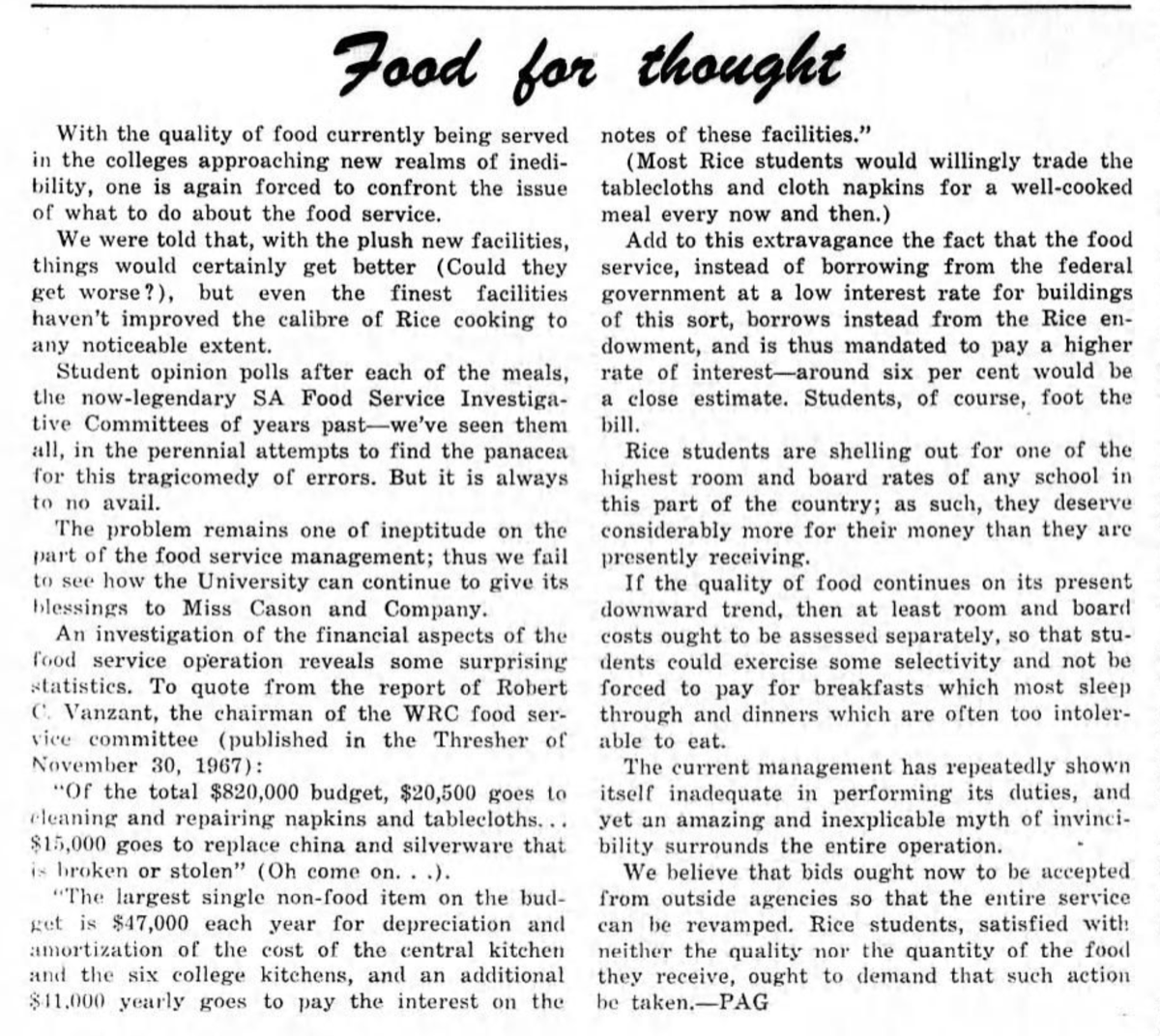
Thresher, May 25, 1918 p. 2 | Thresher, Feb. 29, 1968 p. 2
For all the protests Rice students have had against the quality of food and other features of the campus, perhaps the most spectacular example is the Masterson crisis of 1969. When the students and faculty learned that the Board of Trustees appointed a new president - William H. Masterson - without their involvement, they protested so intensely that Masterson ended up resigning five days after his appointment was announced. There's a great video by Melissa Kean that goes over what happened:
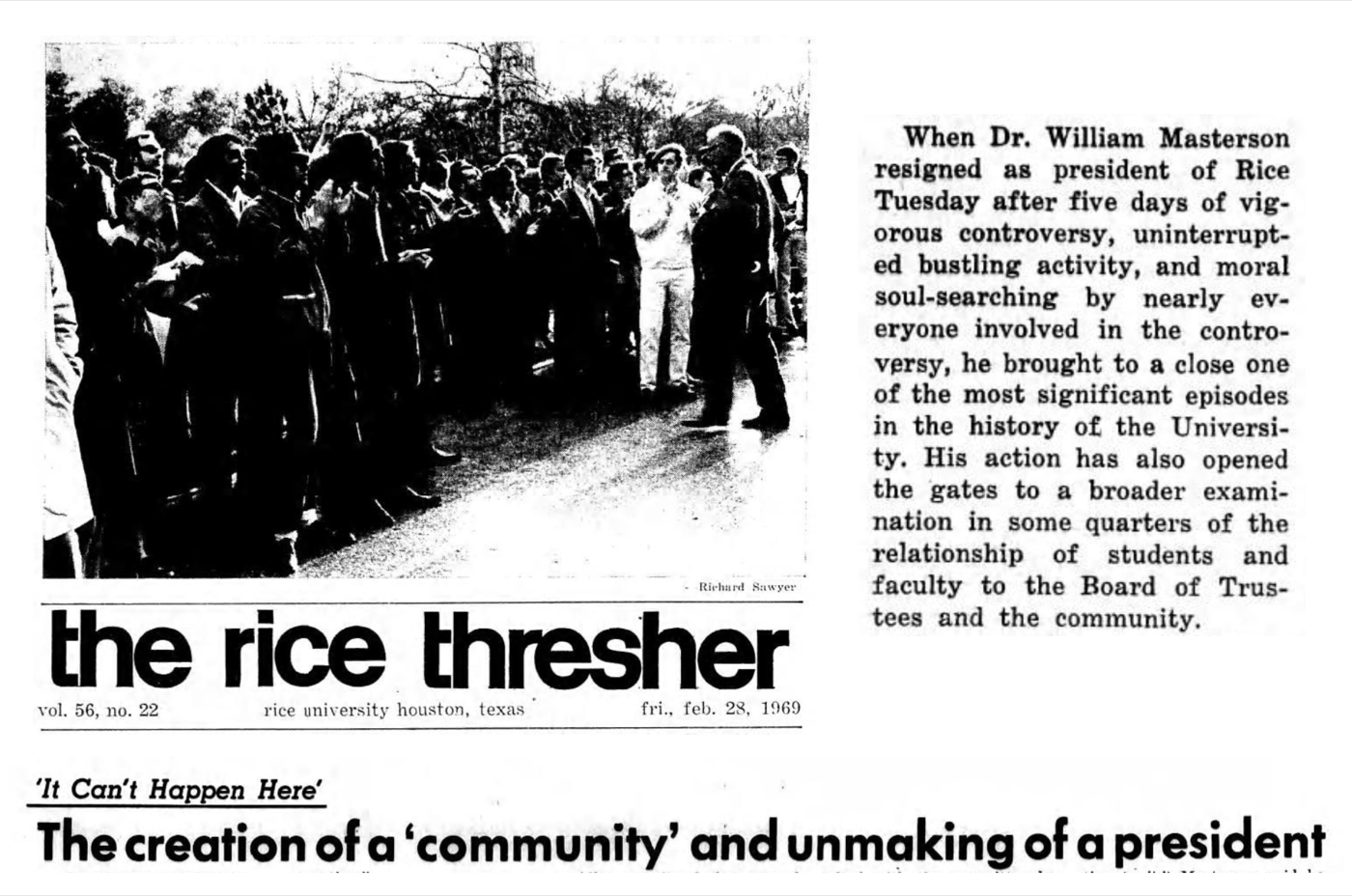
The Thresher called it "one of the most significant episodes in the history of the University," which is probably true, and yet I think most students would be surprised to hear that such an episode ever happened. They'd be more familiar with the Civil Rights Movement that had taken place in parallel, a movement that made its most indelible mark on Rice in the form of the decision to begin allowing Black students to attend in 1963/64.
Research from Rice's Task Force on Slavery, Segregation and Racial Injustice highlighted that the push to desegregate was "a decision spurred mainly by financial and aspirational motives rather than a commitment to advancing civil rights." According to a 1961 poll, the students and faculty were generally in favor of desegregation, though a decent chunk of them were not, which is unsurprising considering the politics of the era. A consequence of Rice breaking with the mandate of its charter to only admit white students was that it would also no longer be tuition-free, which may have influenced how this vote went.
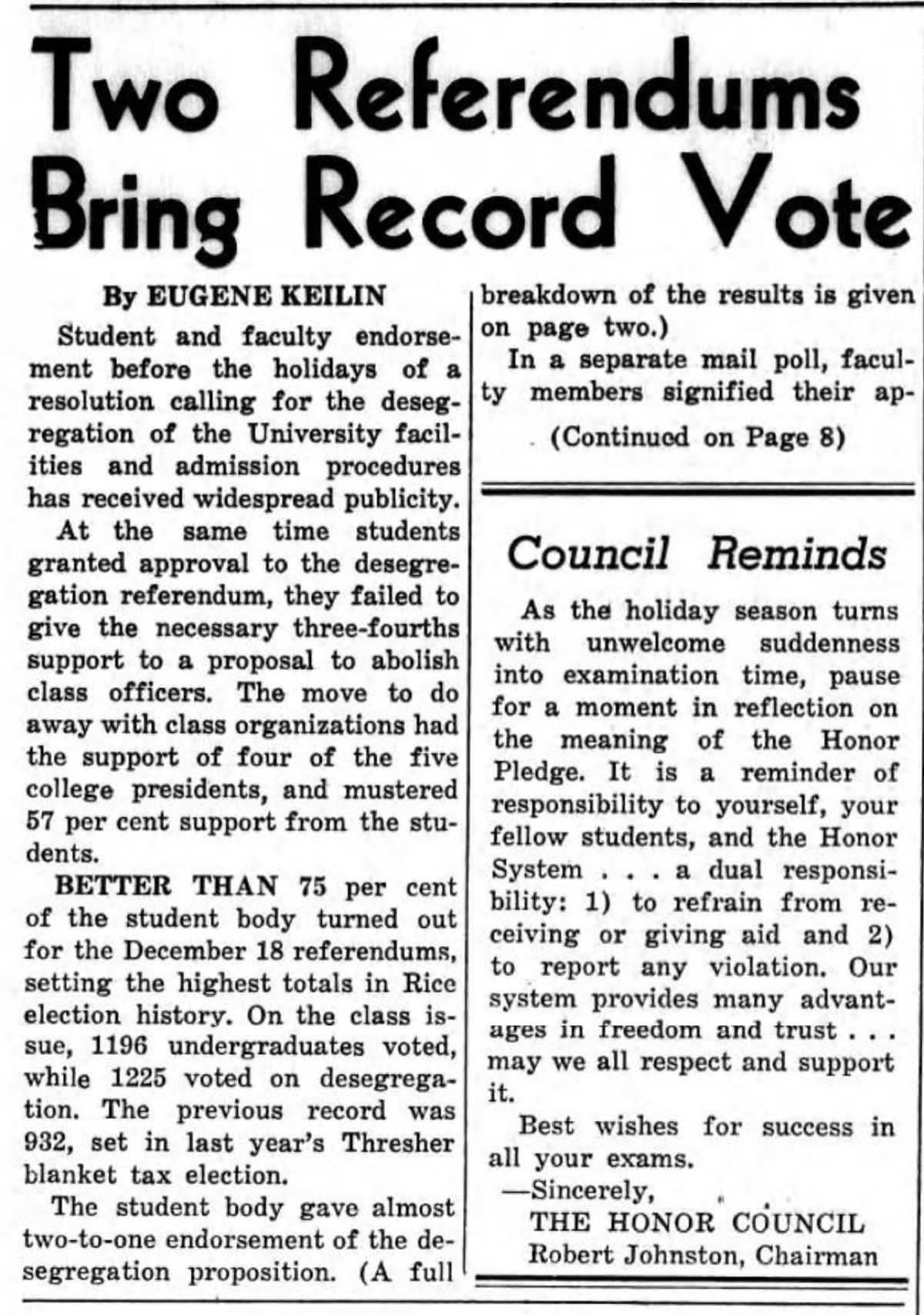
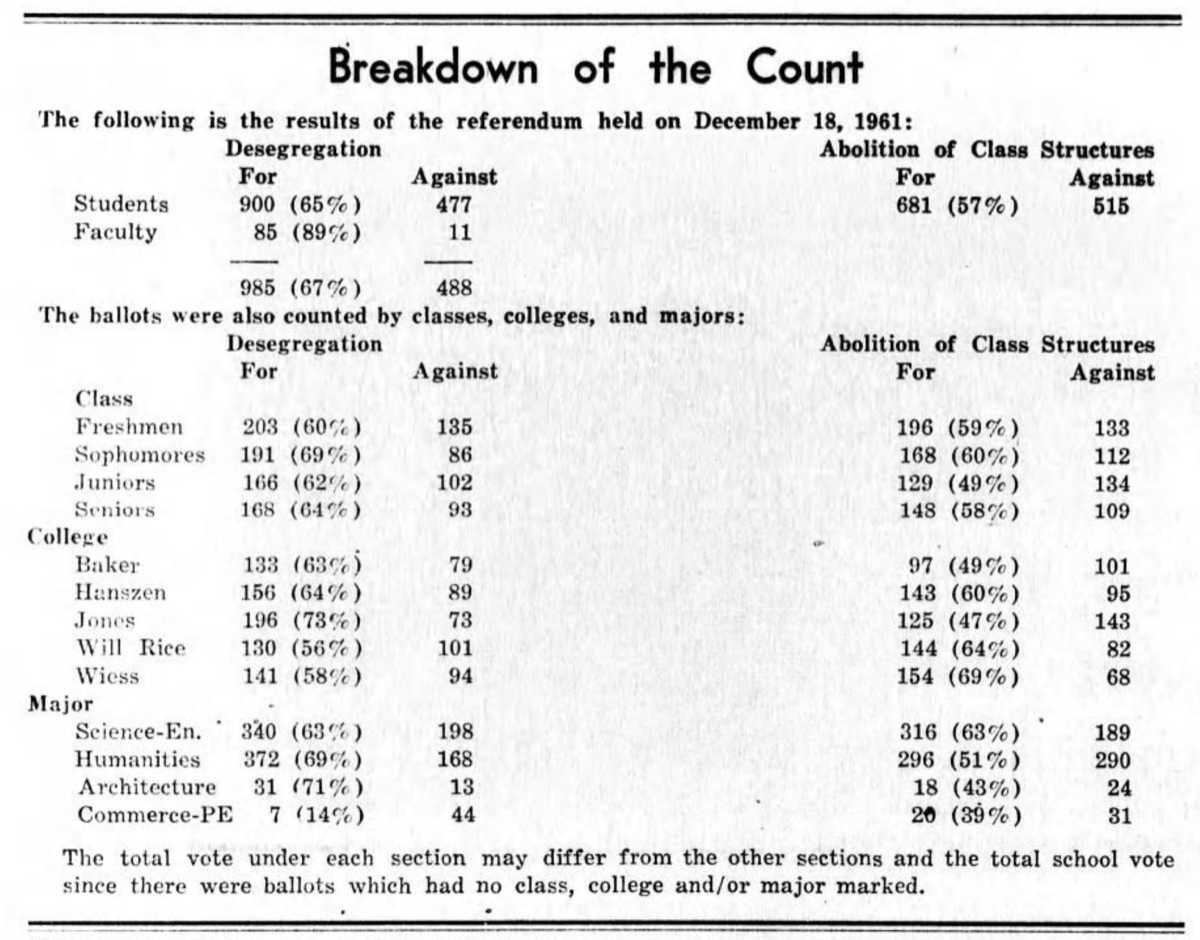
Thresher, Jan. 10, 1962 p. 1 | Thresher, Jan. 10, 1962 p. 2
In searching through this archive, I found some moments of Rice's history that were especially unsavory. An example of this was a series of minstrel shows held at Hanszen College in the early '60s, the descriptions of which are themselves shock-inducing. I haven't included the worst of it here.
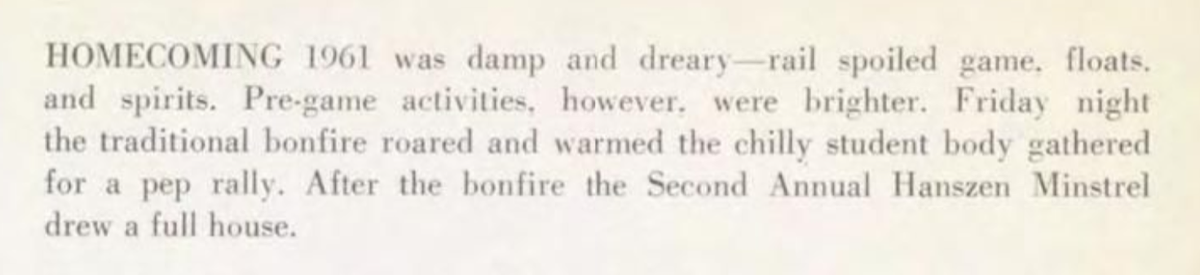
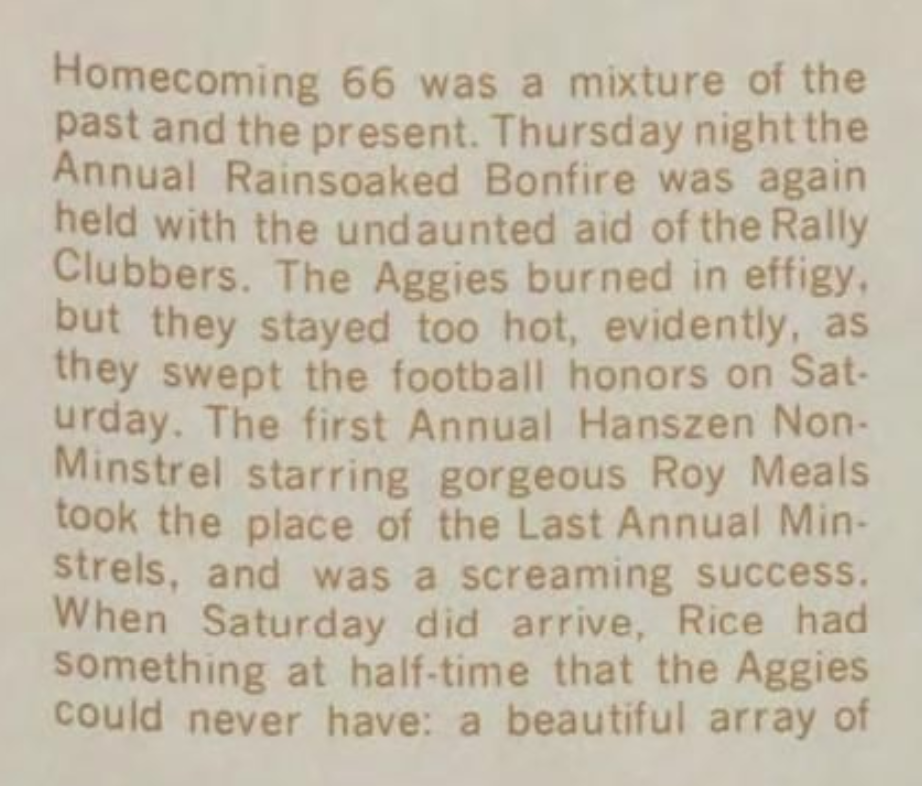
1962 Campanile p. 259 | 1966 Campanile p. 41
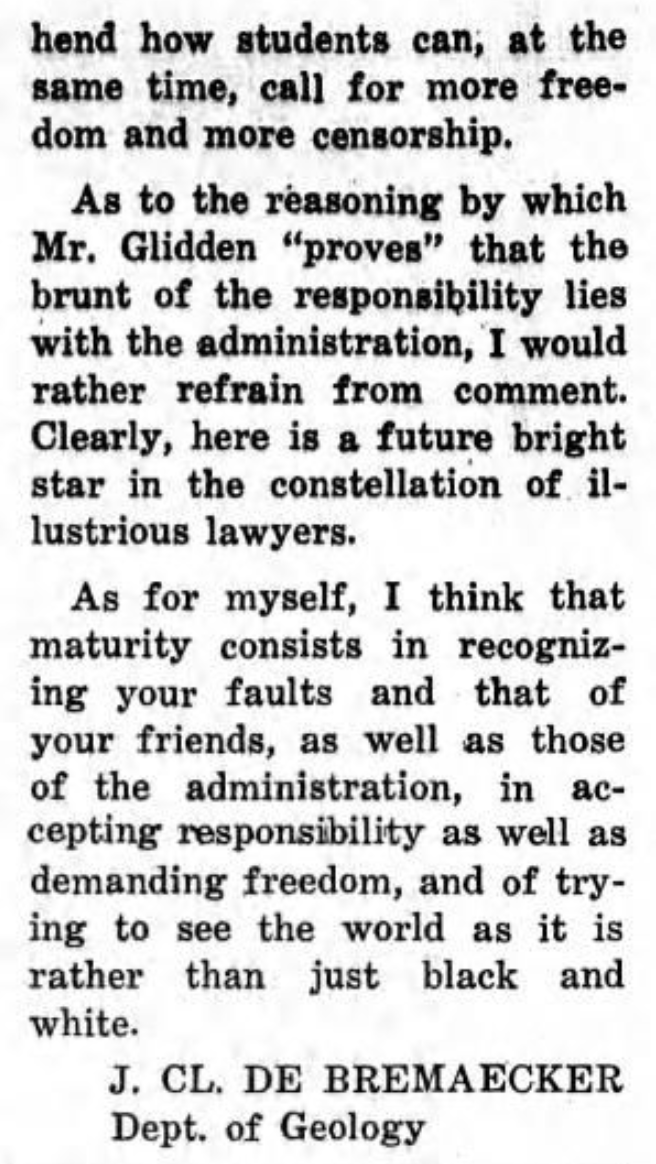
However, one thing that became clear as I continued exploring was that Rice has never been a monolith. Some students at the time took offense to the display, and one in particular (the then-president of ACCORD) wrote an opinion that dressed down the performance, albeit in language that's now dated. Here we also see a recurrence of a pattern for college campuses that might be familiar to us today: there was a backlash to the backlash in the form of an opinion from a professor disagreeing with the show but arguing that their right to free speech should enable them to perform it.
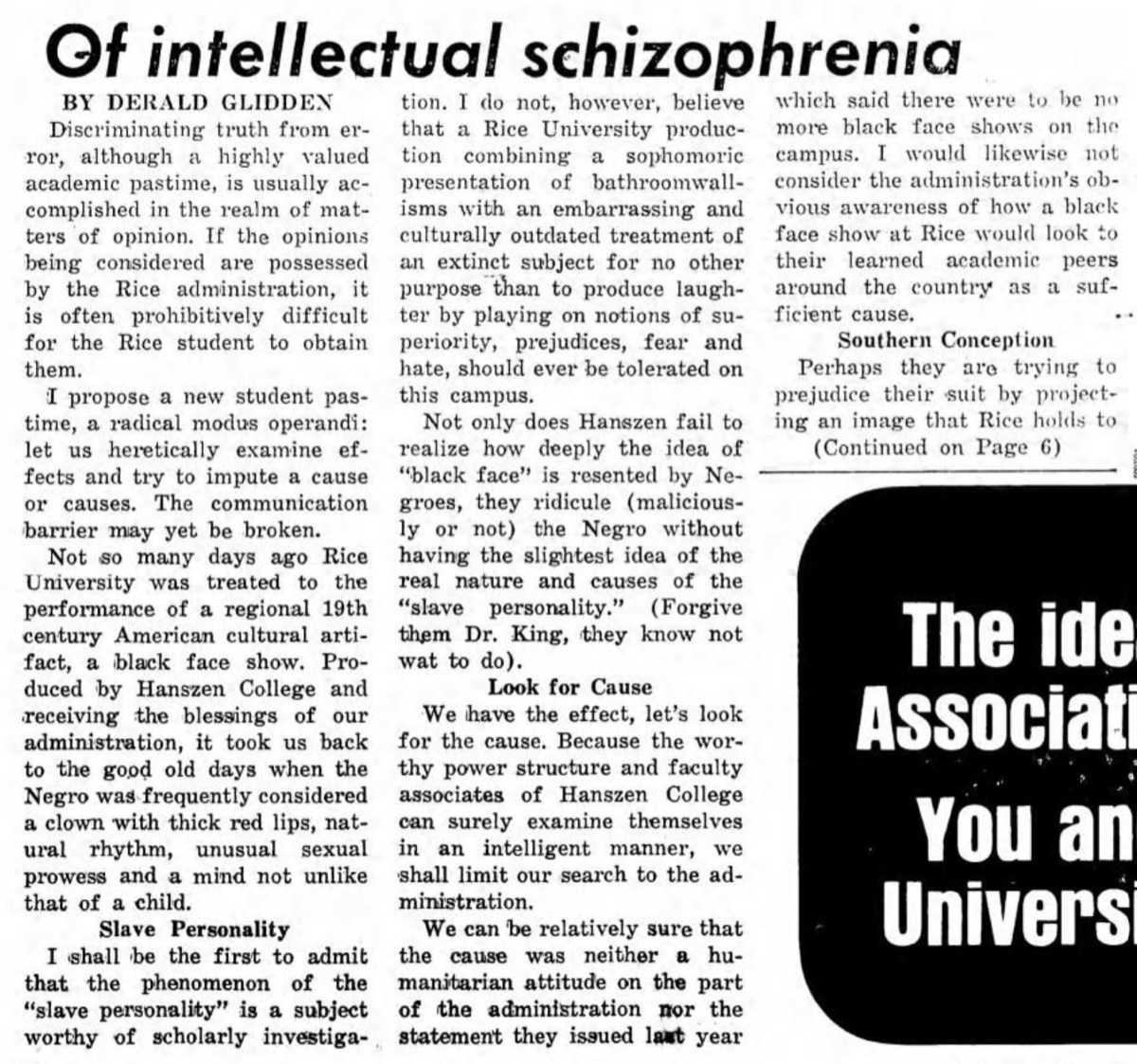
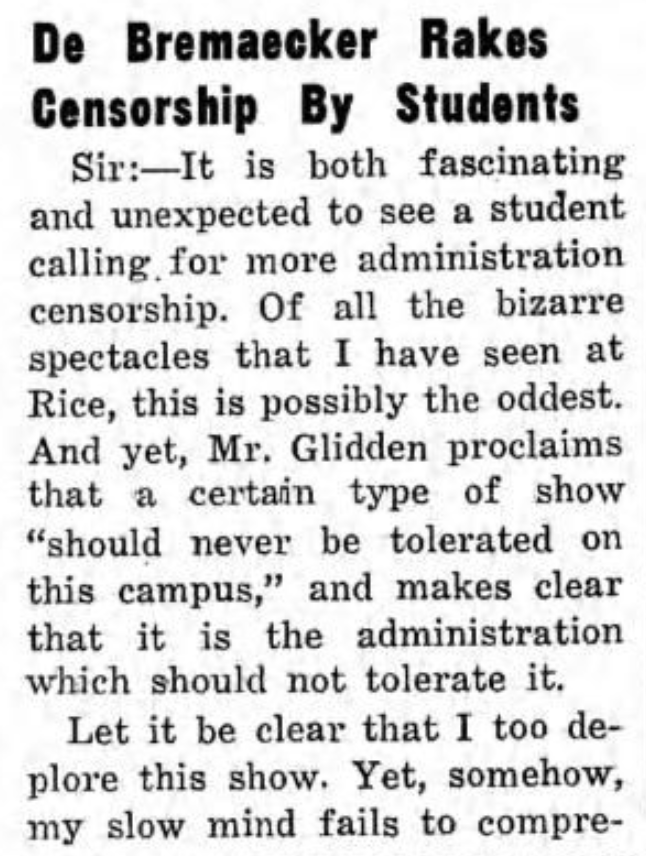
There's so much more to explore in this archive, and I've omitted many details for clarity and brevity, but it's been a fascinating experience searching through it in natural language and diving deep into topics to get a sense of what life was once like for a student like me before my time.
If you do decide to dive into it like I did, it's important to keep in mind what we're looking at. This archive is a time capsule, not a time machine: it's a record kept by people whose job was to edit it in the process of preserving it. Occasionally you will see the explicit hand of the editor, but even if it doesn't present itself that way, it's always there. It's also a record made for the contemporary members of the Rice community, so the articles may gesture to an atmosphere or context that the intended audience may be familiar with, but you will have to explore further to understand that context.
I highly recommend checking out the collection of Thresher and Campanile editions, along with many other records of history relating to Rice, over at the Woodson Research Center's Digital Collections official website. The archivists there have done excellent work to compile these resources and publish them. They've also done the work to showcase the kinds of stories of the Houston community that are too often untold, like in the case of the reports from the Task Force on Slavery, Segregation, and Racial Injustice.
You can also read more stories collected by Rice's former Centennial Historian Melissa Kean at her blog Rice History Corner. I recommend her blogs about the time that A&M kidnapped Sammy the Owl, or her writings about the cast of characters who have been involved with Rice, which tell a deeper story about their contributions to the university.
If you're more technically oriented, you can also explore the archive in the way that I initially did from the OCR data I collected. I've published the portion of the archive that is in the public domain here: github.com/fadilf/rice-student-publications-ocr. You can either clone it from GitHub or paste the link into an online agent chat like Claude or ChatGPT and ask it to explore the repository to answer your questions. You might be surprised by what you discover. If you find anything interesting, please let me know!