SpeakEasy: Silent Comms for the Battlefield
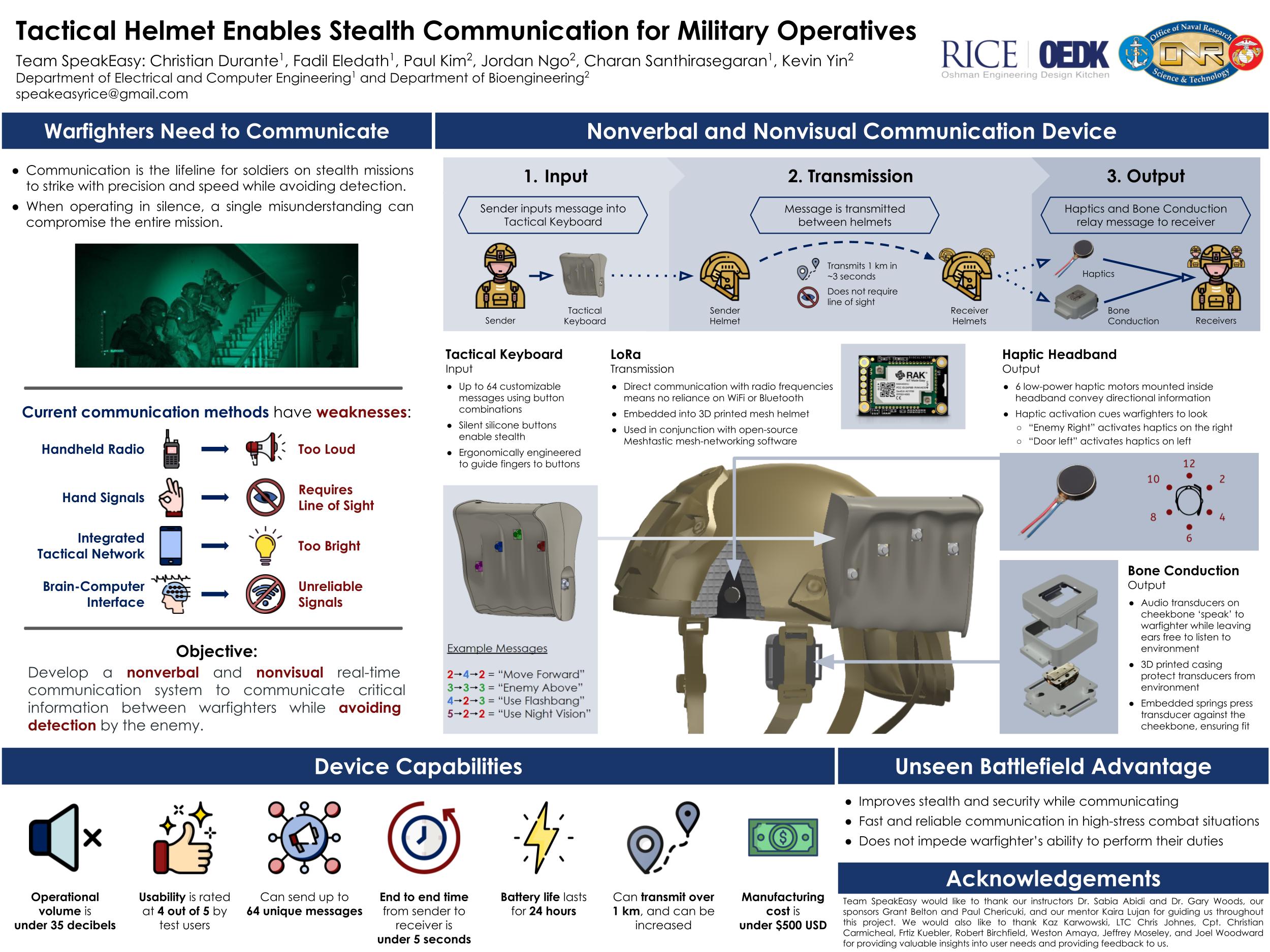
SpeakEasy was a two-semester design project at Rice's Oshman Engineering Design Kitchen (OEDK), sponsored as part of a larger Smart Helmet effort supported by the Office of Naval Research. Our team of six (three from ECE, three from Bioengineering) set out to answer a simple question: how do soldiers talk to each other when they can't speak and can't see each other?
The problem
Radios are loud, and hand signals need a line of sight. Modern combat is a bad place for either: an unsilenced M4 fires at around 160 dB, normal conversation sits around 70 dB, and a squad trying to stay undetected can't afford to say a word. Through interviews with veterans, ROTC students, and our sponsor, we turned this into a handful of hard specifications:
- Operational volume no louder than a low whisper
- End-to-end message time under 5 seconds (input, transmission, and the receiver understanding the message)
- At least 30 distinct messages
- Battery life over 24 hours
- Transmission range of at least 1 km
The system
The device splits into three stages: input, transmission, and output.
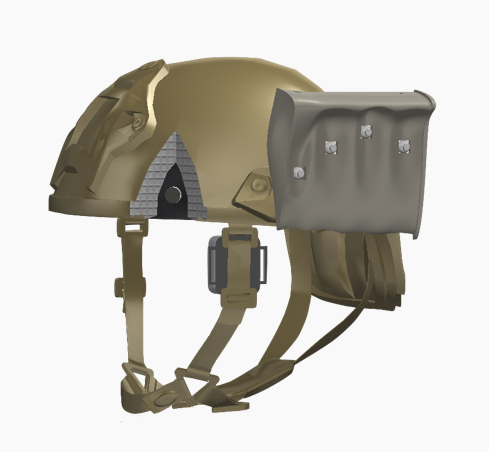
Input: the tactical keyboard. A 3D-printed unit on the left side of the helmet with five silent silicone buttons. Hold the thumb button, tap a sequence on the other four fingers, release, and the message is sent. Sequences map to a library of up to 64 commands (for example, 2-4-2 for "Move Forward").
Transmission: LoRa mesh. LILYGO T-Beam boards running Meshtastic pass messages from helmet to helmet over radio, with no Wi-Fi, no line of sight, and about 3 seconds to cover 1 km.
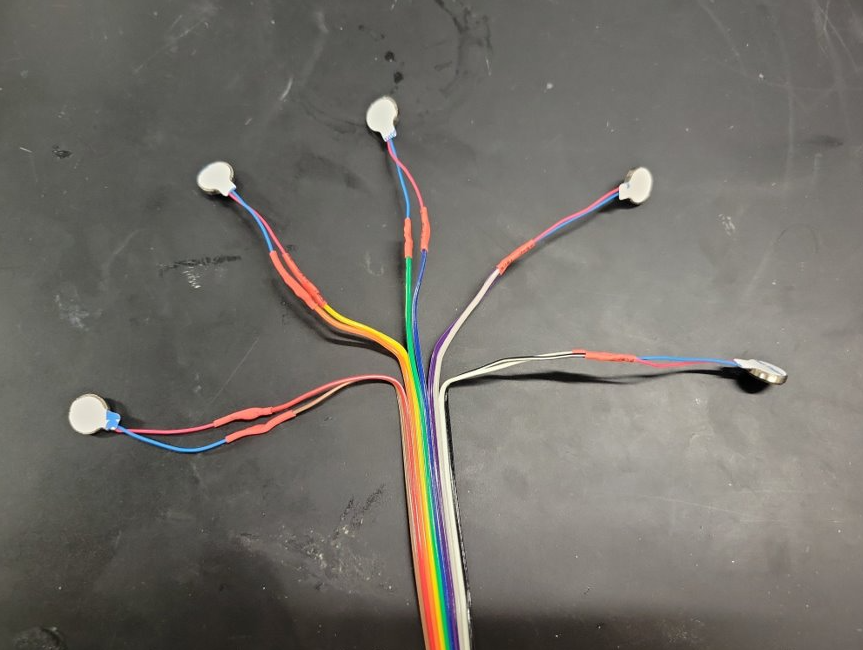
Output: bone conduction and haptics. A bone conduction transducer pressed against the cheekbone speaks the message through the jaw, leaving the ears free for the environment. Six haptic motors laid out like a clock face add direction: "enemy right" buzzes the right side of your head before the audio finishes.
What we measured
| Specification | Target | Result |
|---|---|---|
| Operational volume | Low whisper | About 35 dB |
| End-to-end time | Under 5 s | Under 5 s |
| Unique messages | 30+ | 64 |
| Battery life | 24 h | Over 24 h |
| Range | 1 km | 1 km in about 3 s |
| Usability | Usable by warfighters | 4 out of 5 from test users |
My contributions
I worked across the output hardware, testing, and the electronics that tie everything together.
- Haptic headband. I owned the haptics from the first prototype in Cycle 2 through the finished headband in Cycle 3: six coin motors, driven from an ESP32, placed to correspond to clock positions around the head.
- Bone conduction output. I built this with a teammate, from a proof of concept through the text-to-speech playback pipeline on the ESP32. A command library of pre-generated voice clips is looked up by the message number that arrives over LoRa.
- End-to-end timing methodology. I redesigned our timing test rig so we could measure the full path from a prompt on the sender's screen to the receiver's response, which is what let us claim the under-5-seconds spec honestly.
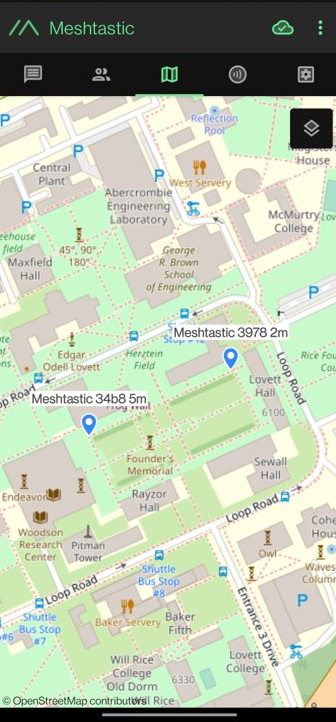
- Mesh networking and location. I ran the mesh network tests, and with a teammate explored using Meshtastic's built-in position reporting to show where each squad member is (the screenshot below is two nodes on the Rice campus).
- PCB design and hardware integration. With two teammates, I worked on consolidating the perfboard wiring into a custom PCB, and on getting every peripheral running from battery power.
- Research and stretch goals. I surveyed ATAK and 5G options for transmission, and took on volume scaling for the bone conduction as a stretch goal.
Future possibilities
The prototype met its specs, but it left plenty of room to grow, and the gaps we hit point to the next steps:
- Volume scaling for bone conduction. It was clear in a quiet room (30 to 40 dB) but not calibrated for loud environments. Adjusting volume to the surrounding noise would make it usable in the field.
- Better-tuned haptics. Finding a vibration strong enough to notice but quiet enough to stay stealthy was hard, especially once the motors were embedded in the helmet rather than touching skin.
- A redundant input. Our gesture-recognition glove (gyroscope and accelerometer) never made it into the final design. A camera-based input could fill that role instead.
- A smaller, tougher build. A custom PCB would shrink the electronics, and ruggedized enclosures would bring it closer to military standards for shock and water resistance.
- Integration with Team HeadsUp. That team built an acoustic threat-detection system for the same helmet. Their smart-glasses display could show incoming commands as text, and the haptic motors could share a priority queue, since stealth messaging and gunfire detection rarely overlap. The main hardware change would be porting our ESP32 code to their Raspberry Pi.
Looking back, the biggest lesson was focus: we tried a lot of options in parallel. Next time I'd pick one simple transmission path and make it rock solid before adding anything else.
Team
Built with five teammates from Rice's ECE and Bioengineering departments, with thanks to our sponsor, instructors, and mentor, and to the veterans and ROTC students who gave us feedback.